
Un-Banished 0.2.0 · 19 October 2026
Boomtown
Every town in Banished starts with a few families and a pile of supplies. Some towns grow into cities of a thousand people, and that is where the original game starts to struggle. Version 0.2.0 is about those big towns. They now run twice as fast, and they look exactly the same as before: not one save, not one frame of the game has changed.
Driscola, 1,024 citizens
Driscola is a real town. A player built it in the original game in 2015. It has 1,024 citizens, 448 wild animals and about 28,000 objects: trees, houses, fields, fences, stones and piles of goods. It is also on fire.
We use Driscola as our stress test. At the highest game speed, one frame of Driscola took 94 milliseconds in Un-Banished 0.1.0. That is about ten frames a second. Most of the time went to work that the game did again and again for no reason. For example, every citizen looked at every object in the town about twice in each step of the simulation. In each step, the game also compared the whole 512 × 512 map about six times, to see if anything had changed.
Now the game remembers what it already knows. The citizens' view of the town is built only for objects that matter to them, and the map keeps a counter that goes up when something changes.
The video at the top of this page is Driscola at speed 10.
The GPU does half the work
A frame is drawn three times. First, the sun's view, to make the shadows. Second, the town upside down, for the reflection in the water. Third, the view that you see. In 0.1.0, every tree and every house was drawn in all three, even when it was far outside the picture.
We measured each part of the frame and found the biggest cost in an unexpected place: the ground under the water. Every piece of terrain was drawn into the reflection, and the water shader then threw most of it away. Now each part of the picture gets only the trees, houses and pieces of ground that it can see. In the view that you see, that is about 2,700 of Driscola's 25,800 models.
Proof that nothing changed
Un-Banished must play exactly like Banished, and every new version must play exactly like the one before it. "Exactly" means bit for bit. So before we changed anything, we built a tool to check it.
tools/compat builds any two versions of Un-Banished side by side. It plays the same towns in both: a new game, a small town, a town of 116 citizens and Driscola. Then it compares every saved game and every picture. It also lets each version continue the other's saves. Every change in 0.2.0 passed this test with identical results.
Once, the test found a difference. The cause was not the change, but the test itself: the save was written a few frames later in one run than in the other. We fixed the test. This story is in Compatibility between versions.
Rocks and ore, the way they were
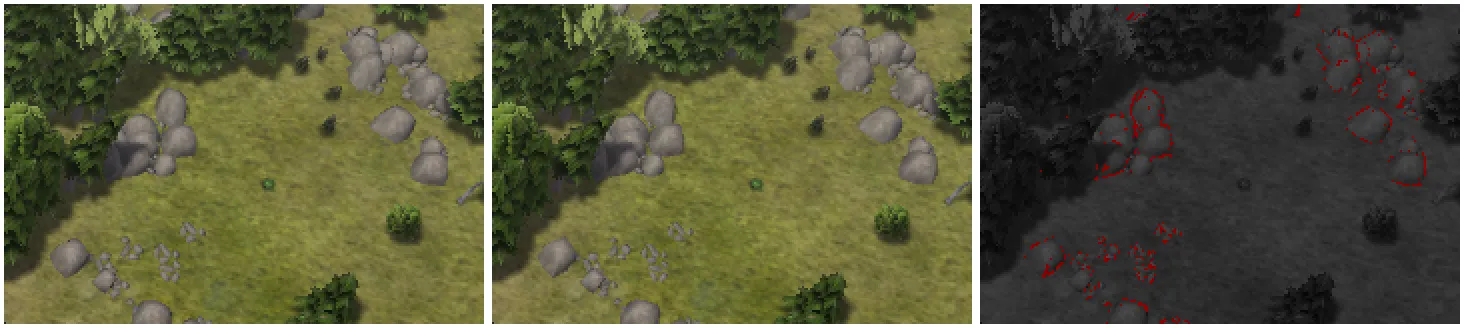
In tracing how the original draws its models, we found one small thing that we did wrong. Three rocks and three ore deposits have a second, simpler model, used when the camera is more than 50 to 70 units away. Un-Banished always used the detailed one. Now it switches, as the original does.
Mods: a manager, and Nexus Mods
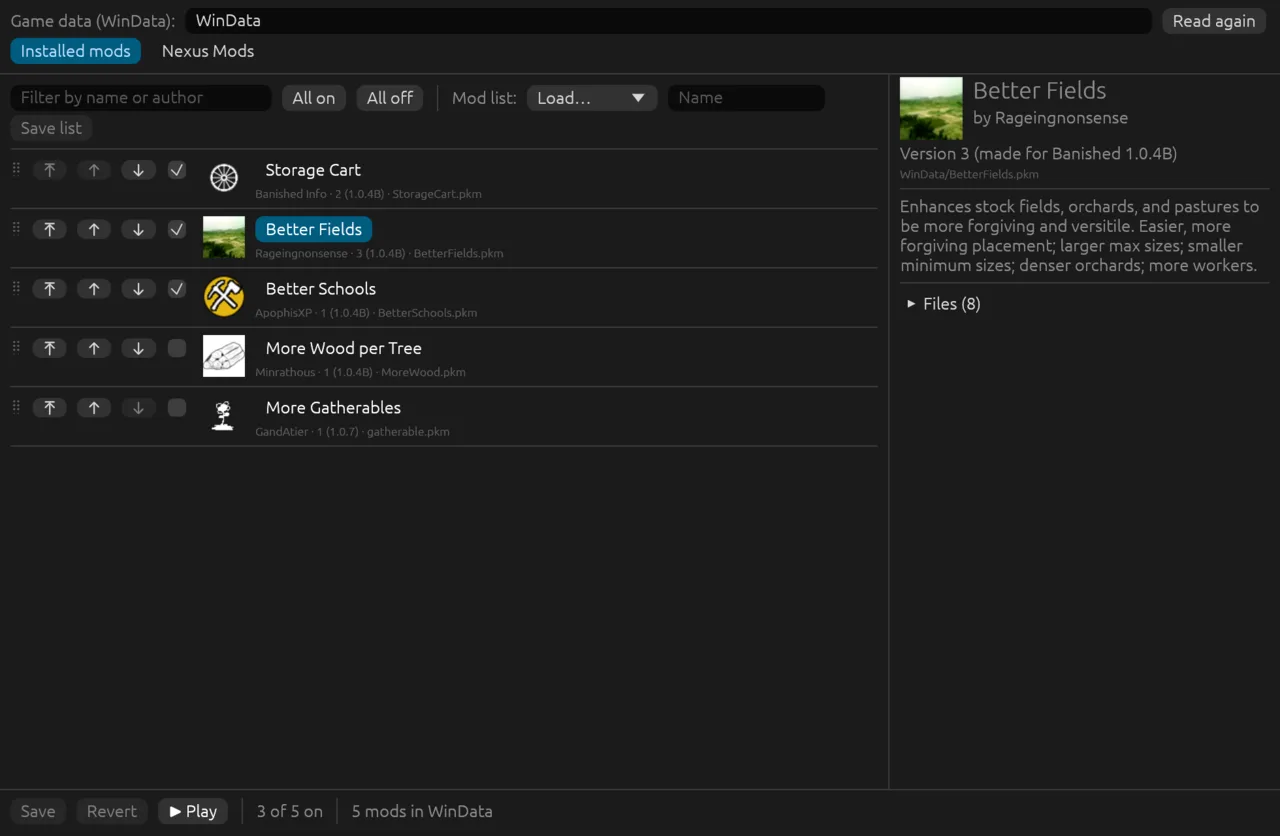
Banished has a large mod community, and many mods are on Nexus Mods. There is now a mod manager, banished-mods. In it, you can turn mods on and off, set their order, keep named lists of mods and start the game.
If you have a Nexus Mods account, you can also give the game your own Nexus Mods API key. Then the Mods menu's Browse tab (where the Steam version shows the Workshop) searches Nexus Mods for Banished mods and installs them. The same works from the command line with banished-cli nexus. See Mods in the guide.
The trader's boat comes home
Merchants arrive by boat with goods, seeds and livestock to trade. In 0.1.0 they did arrive, and they did trade, but nobody could see them: the boat sailed up the river without being drawn. Now the boat is back on the water, with its hull, its cargo, its oars and the merchant at the oars.
People at work, up close
Every video in this post was recorded by Un-Banished itself, without a window: the game runs, a script moves the camera, and each frame is saved and joined into a video. The game's own camera stays high above the town, as in the original, so for this release we gave the recordings a camera of their own. It can fly along any path, or ride behind a citizen, a boat or an animal and look where they are going. When a roof or a tree comes between the camera and its subject, it moves closer or rises, so the view stays clear.
With it, for the first time, you can see the people of a Banished town at work, close enough to see what they carry. Anyone can make videos like these with tools/videos.sh; Recording videos explains how.
A new front door for the browser
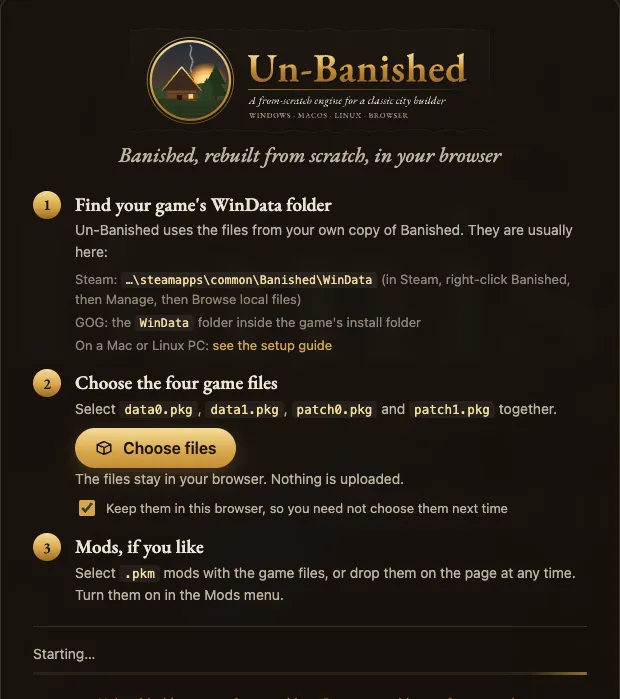
The browser version now opens with its own loading screen. It explains, in three steps, where to find the game files on your computer and which four to choose. The files stay in your browser; nothing is uploaded.
No freeze after loading
When a town appeared after loading, the game used to stop for about half a second. It was decoding the sounds of the town and the first piece of music, at the moment you wanted to play. Now this happens behind the loading screen.
Loading itself is also faster on computers with more than one processor core. The game's pictures, sounds and models are now decoded on all the cores at the same time. Starting the game and loading a save take 20 to 55 % less time. (The browser version still loads on one core.)
Under the floorboards
The code is now in smaller pieces. The exact maths, the terrain and the path finding are now their own libraries: banished-core, banished-terrain and banished-path. The largest files are split by topic. None of this changes the game, and the compatibility test proves it.
The documentation grew too. The website has new Guide, Develop, Topics and Reference sections. Every app and library has a README, and the Rust API documentation is written in plain English.
What is next
The work on large towns continues: the decals and the shadows are the next largest costs on the GPU. We also want to find out why a few frames can differ between two runs of the same version (the saves never do).
If something does not play like the original, please report it.
All changes: Changelog, version 0.2.0 · Earlier: First Settlers, 0.1.0 · Next: Neighbours, 0.3.0