
The work loop
These guides explain how a behaviour of the original game becomes tested Rust code in Un-Banished. Every ported part of the game went through the same steps. The guides describe each step, the tools for it, and the mistakes that are easy to make.
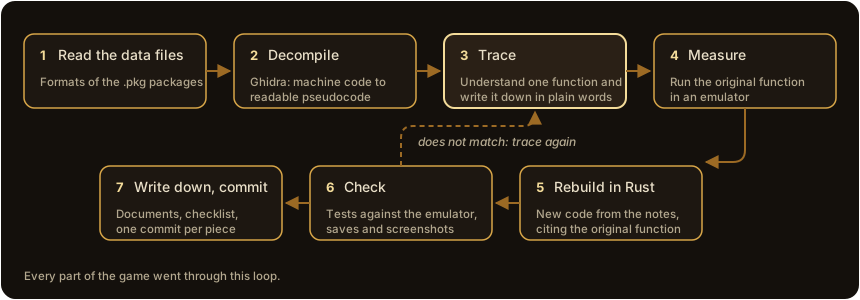
The steps
| Step | Guide | Result |
|---|---|---|
| 1 | Trace | You know which original functions do the work, what they read and write, and what their constants are. |
| 2 | Emulate | You have the exact output of the original functions for many inputs. (Only for numeric work.) |
| 3 | Decode a format | Un-Banished can read the resource or save block that the behaviour needs. (Only when it cannot yet.) |
| 4 | Port | The behaviour is in Rust, and each function names the original it came from. |
| 5 | Port a shader | A material draws as in the original. (Only for graphics.) |
| 6 | Verify | Tests, captures and the browser build show that the change works. |
| 7 | Document and land | The findings are written down, and the change is committed and pushed. |
A typical change runs: trace, then (emulate), then port, then verify, then land. If a check fails, go back to tracing. Do not guess to make a test pass.
What you need
- Your own copy of Banished 1.0.7 (Steam build 170910, Windows x64), copied into the project with
tools/extract-assets.sh. See Building. - Ghidra 12.1 with JDK 21, to decompile the original program. On macOS:
brew install ghidra. Then runtools/ghidra/export.shonce. It takes about 20 minutes. It writes the readable pseudocode of every function toanalysis/export/<program>/decomp.c. - Python 3 with a virtual environment for the emulator:
python3 -m venv .venv && .venv/bin/pip install unicorn pefile.
Git ignores game-data/ and analysis/. Nothing in them may be committed.
The two original programs
| File | What it contains | Base address |
|---|---|---|
Application-steam-x64.exe | The game's logic: citizens, buildings, the game loop, saves | 0x140000000 |
Runtime-steam-x64.dll | The engine: files, maths, random numbers, the interface, sound | 0x180000000 |
Functions are named by their address, as Ghidra names them: FUN_1400be770 is the function at address 0x1400be770 in the program. The Runtime exports its functions with C++ names, so many engine functions have real names, for example UI::Element::SetChild.
Before you start
Read GAME-LOOP-CHECKLIST.md. It lists what is done and what is still open. Then search docs/ for the addresses, resource names or class names you are about to work on. Much has already been traced:
grep -rn "FUN_1400be770\|Toolbar" docs/ | headThe rules that matter most here
- Never copy decompiled code, disassembly or resource bytes into the repository. Describe what you found in words, tables, addresses and constants.
- Every ported function names the original function in its doc comment. A guess says inferred or assumed.
- Every intentional difference from the original has a
Deviation:comment.
These guides were first written as instructions for AI coding agents. They are in .claude/skills/*/SKILL.md. The guides here say the same things for people.