
The interface
Banished ships its interface as data. Every window, button, list and tooltip is a resource in the Dialog folder of the packages, drawn with the game's own sprite sheets and fonts. Un-Banished does not draw its own copy of these windows. It loads the same resources and lays them out as the original engine does. The code is in banished-ui, and the windows' behaviour is in apps/game/src/ui/.
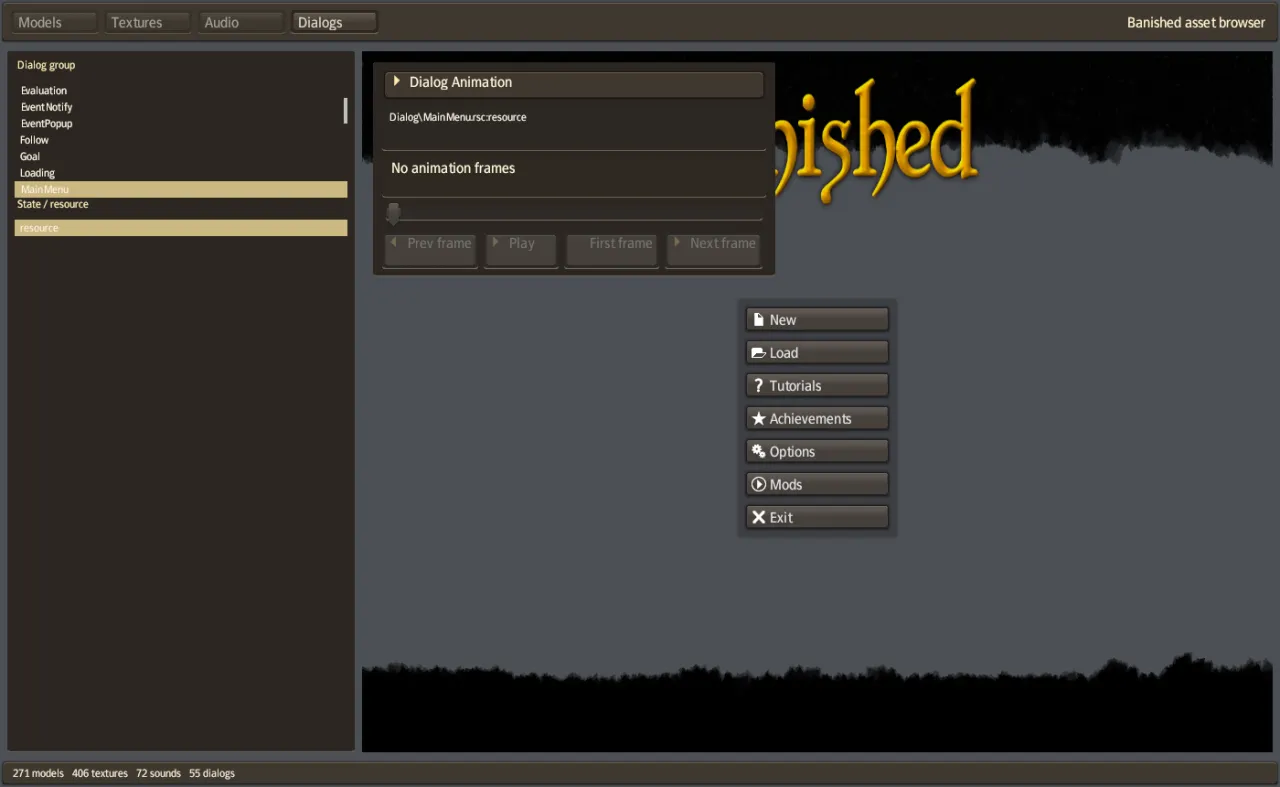
Dialogs and elements
A dialog resource (Dialog/*.rsc) is a tree of elements. There are many element classes: groups, layouts, tables, tabs, text, images, buttons, check boxes, lists, combo boxes, sliders, spinners, scroll bars, progress bars, graphs, edit boxes, and documents with markup. Each element has a name (for example buttonNew), margins, a minimum size, an alignment, and a reference to its sprites or its font.
A dialog can replace parts of itself with other resources by name (substitutions), and it can attach controllers to elements. A controller is game code: for example, the code that fills the Town Hall's tables. The resource only says which controller goes where.
Layout
Layout runs in two passes, as in the original engine:
- Size, bottom-up. Each element computes the size it needs from its children, its text and its margins (
ComputeSize). - Place, top-down. Each element places its children inside the rectangle it was given (
ComputeLayout), by their alignment and the rules of its class.
Text layout follows the original font code: the advance of each glyph, line wrapping, ellipsis and the shadow. The help pages and the tutorials use documents with markup, with links and pictures.
Drawing and input
The interface draws as a list of textured quads, in order, each with an optional clip rectangle. banished-gfx draws them with wgpu in one pipeline. The pointer and the keyboard go through the element tree: the element under the pointer is hot, a pressed button sends a click when it is released, and an edit box takes the keyboard focus.
How the game uses it
The game finds elements by their names, as the original does. It never depends on the position of an element in the tree. For example, the toolbar finds toolbarContent and fills it from the toolbar resources. Strings come from string tables, so the game shows the texts of the original.
The same names make headless tests possible: --press buttonNew@4.5 clicks the element called buttonNew in a capture. See Verify.
Read more
- UI.md: the element classes and their engine functions.
- FONTS.md, TOOLTIPS.md, STATUS-ICONS.md.
- IN-GAME-TOOLBAR.md, UTILITY-WINDOWS.md, BUILDING-WINDOWS.md, OPTIONS.md: the game's windows.
- The viewer draws every dialog of the game.