Cars that touch, and the damage they take
2026-10-24, the pod-physics session.
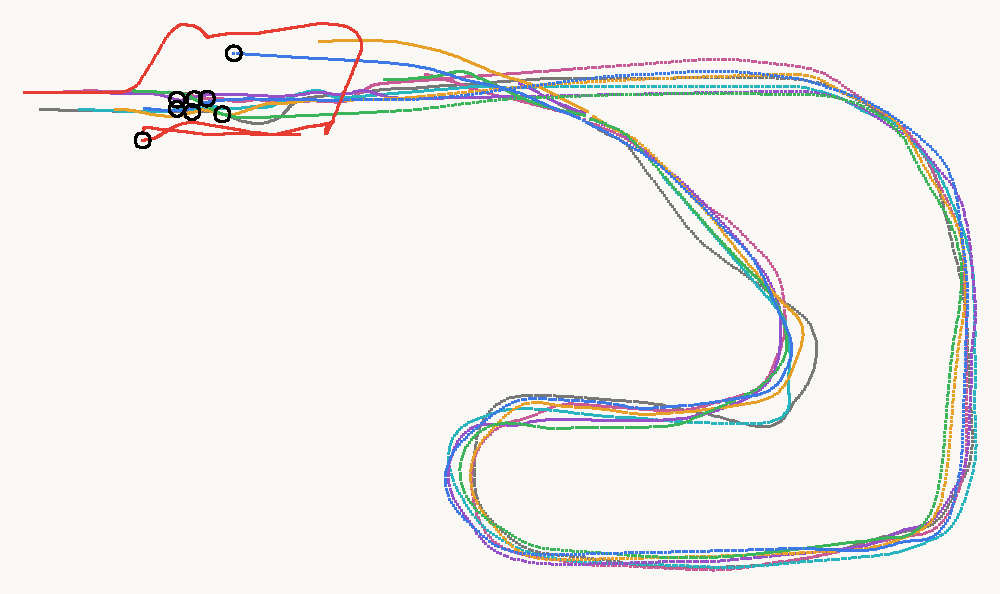
The recorded Gold race (derived/physics/gold-beltane). Until today the port could follow each computer car only until another car touched it, here 173 to 218 steps. With collisions in, it follows all eight to the end.
Collisions
After every car has moved, POD tests each pair of cars once. Each car has a collision box that comes with its drawn model. The model's frame comes straight from the car: its three axes and its centre, lowered by half the box's height. Two boxes touch when their reach towards each other, along the line between their centres, adds up to more than the distance between them.
Then the game checks which body parts of each car are near the contact, and goes on only if both cars have one. Each car gets an impulse along whichever of its own axes lines up best with the contact. The impulse comes from how fast the cars close and from their two masses. The cars are pushed apart by half the overlap. A hard hit sets the contact sound.
One quirk turned up in testing. When the game places the two cars' models again after a contact, it also turns their wheels once more by a frame of spin, so a car in contact rolls its wheels twice in that step.
Every call matched under the emulator, over the whole race: 29,148 box tests, 21 real contacts and 1,041 collision passes. Then the real test: the port carried all eight cars from the first step to the last, taking only the drivers' inputs from the recording. Every word of every car matched the game, contacts and the put-back included.
Damage
The race was recorded with damage off, so there was no damage to compare with. Instead the race's contacts ran again inside Gold's own code under the emulator, with damage switched on in both modes. The body parts' health was also set low, so that parts would break.
Each car has six body parts with 2,000,000 health each. A hard hit shares half its strength among the parts near the contact, or among all six in the other mode. A part that runs out runs a small chain of macros that swaps it for its damaged version. The damaged part brings its own health, its next stage and a different collision box. A broken part also hurts the wheels: a wheel loses 5% of its grip and rolls heavier, or a pair loses 3%.
Wall hits inside a car's own step do damage the same way. Every damage call in both modes matched, with 12 parts broken. So did every contact with damage on.
Next
The damage record that the race display shows is left to the display code. The emulated PC could record a race with damage on, and on a track with jumps, to check these against a real race instead of a re-run one.