POD's sun flare now draws after the world
The 16-bit cloud pass returns the sun's screen position when the track enables its dome and sun mode. Un-POD now places the measured marker at that position before drawing the horizon. The pod-render path checks the marker after textured and color world faces, then draws the measured F0 RGB565 flare only if both marker bytes remain. This preserves the original occlusion rule: a roof or other foreground face can hide the flare.
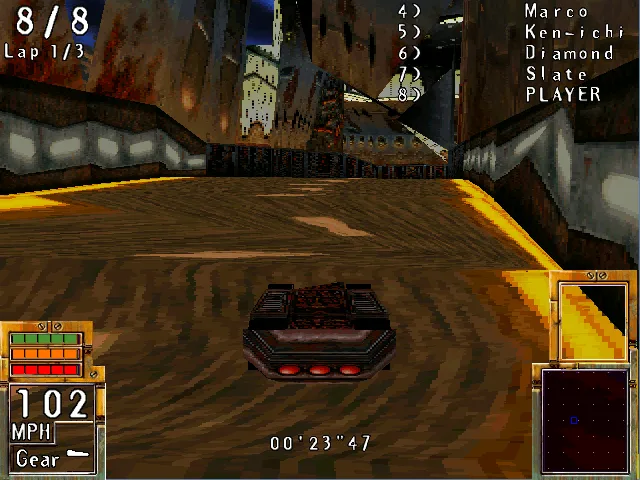 Un-POD after 400 release-probe passes on Beltane. This is the app's output, not a same-camera comparison with
WINPOD.EXE.
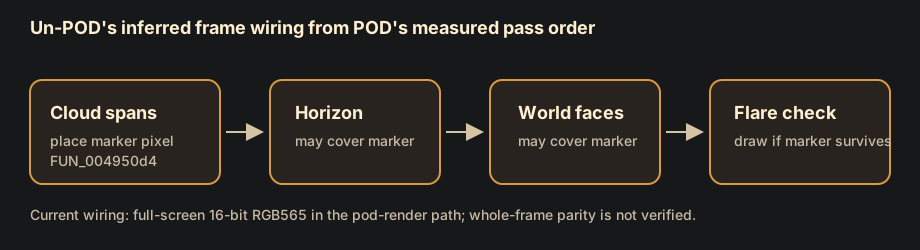 The marker is laid down with the cloud spans; horizon and world pixels can cover it before the flare's visibility check.
The flare implementation itself was already measured against POD 2.8. This change wires it into the app. New tests check that the cloud pass places the marker and that the post-world flare changes a visible marker but leaves an overwritten marker alone. The Un-POD binary tests pass 19/19, pod-render's full test suite passes, the release build completes, and a release probe advances 400 passes. The browser target also compiles and reports seven unused-code warnings in the browser app.
The frame integration remains inferred from POD's draw_frame_views order. The app still uses its chase-camera stand-in and has no world coverage mask, so this probe does not establish whole-frame parity or settle the reported roof and texture gaps. The stand-in renderer, dithered flare, split screen, and 8- and 32-bit sun paths remain unported.
Next: compare a saved POD lap frame with the Rust renderer at the same camera, then continue with the remaining texture and sky passes. See the renderer notes and the checklist.