Calling conventions, data layout and floating point
This page lists what you need to read a game's machine code correctly and to call its functions under the emulator. The tables list only the details games use. The authoritative sources are linked at the end.
Calling conventions
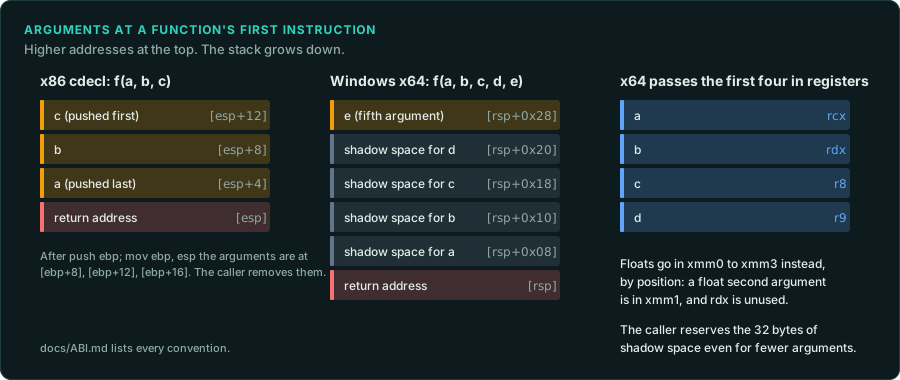
| Platform | Integer and pointer arguments | Float arguments | Return | this | Stack |
|---|---|---|---|---|---|
| Windows x64 (all 64-bit Windows games) | rcx, rdx, r8, r9, then stack | xmm0-xmm3 (by position: the 2nd argument is rdx or xmm1) | rax, xmm0 | rcx | caller reserves 32 bytes of shadow space; stack 16-byte aligned at the call |
| System V x64 (Linux, macOS) | rdi, rsi, rdx, rcx, r8, r9 | xmm0-xmm7 (counted separately from integers) | rax (rdx:rax), xmm0 | rdi | 16-byte aligned; 128-byte red zone below rsp |
Windows x86 __cdecl | stack, right to left | stack (float as 4 bytes, double as 8) | eax (edx:eax), x87 st(0) for floats | n/a | caller cleans the stack |
Windows x86 __stdcall (WinAPI) | stack, right to left | stack | eax, st(0) | n/a | callee cleans (ret N) |
Windows x86 __thiscall (MSVC C++ methods) | stack | stack | eax, st(0) | ecx | callee cleans |
Windows x86 __fastcall | ecx, edx, then stack | stack | eax, st(0) | n/a | callee cleans |
| ARM64 (consoles, Apple silicon, Android) | x0-x7 | v0-v7 | x0, v0 | x0 | 16-byte aligned |
Structures larger than 8 bytes are usually passed by hidden pointer on Windows x64, and returned through a hidden pointer passed as the first argument (so this moves to rdx).
Callee-saved (non-volatile) registers on Windows x64: rbx, rbp, rdi, rsi, r12-r15, xmm6-xmm15. If pseudocode seems to use a value from nowhere, it may be one of these, kept across a call.
C++ layout (MSVC)
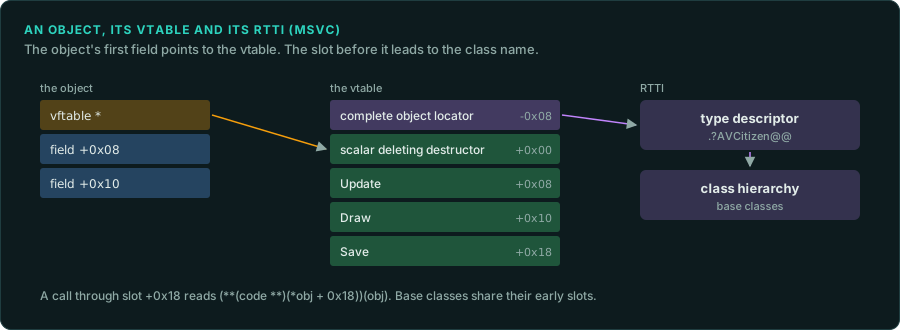
- An object with virtual methods starts with a pointer to its vtable (
+0x00). Multiple inheritance adds one vtable pointer per base with virtual methods. - A vtable is an array of function pointers; MSVC puts a pointer to the RTTI "complete object locator" just before it (at
vtable - 8on x64), which leads to the class name (.?AVCitizen@@). - Virtual destructors take a flag argument (scalar deleting destructor):
FUN(this, 1)deletes. std::string(MSVC, x64): 32 bytes; up to 15 characters stored inline, otherwise a pointer.std::vector: three pointers (begin, end, capacity end).- Member functions are named
?Method@Class@Namespace@@...when exported; any C++ demangler (c++filtunderstands Itanium names; for MSVC usellvm-undnameor Ghidra) turns them back.
Floating point
The same floats on every platform covers what still differs between CPUs, consoles, GPUs and WebAssembly, from the point of view of the port.
A reimplementation is exact only if it copies these details:
- SSE (all x64 games).
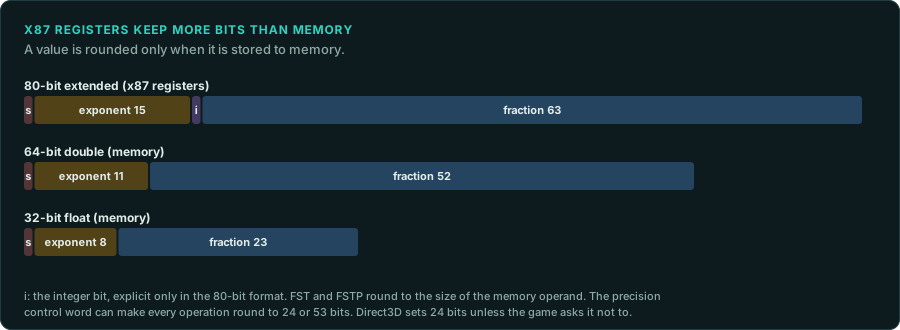
floatoperations are 32-bit (addss,mulss),double64-bit (addsd). Each instruction rounds its result once. Copy the precision of every operation. - x87 (many 32-bit games). The FPU computes in 80-bit precision and rounds only when a value is stored to memory as 32 or 64 bits (
fstp dword). Intermediate results are more precise than either float type; match where the original stores. The precision control word (set by Direct3D 9 to 24-bit by default unlessD3DCREATE_FPU_PRESERVEis used) can make x87 round every result to float precision. - Reversed and popping x87 forms.
fsubcomputesst(0) - src.fsubrcomputessrc - st(0), andfdivrdivides the other way round in the same way. Forms ending inppop the stack afterwards. Ghidra usually writes the right order, but check it where a result looks negated or inverted. The order is the whole difference. - x87 compares.
fcom,fcompandfcomppset C0, C2 and C3 in the status word, read withfnstsw ax.fcomiandfucomi(Pentium Pro and later) set the CPU flags directly, sojaorjbfollows. A compare with a NaN is unordered: all three bits set, or ZF, PF and CF set. Ajpafter the compare tests for it. The port must take the same branch for NaN as the original. - Conversions.
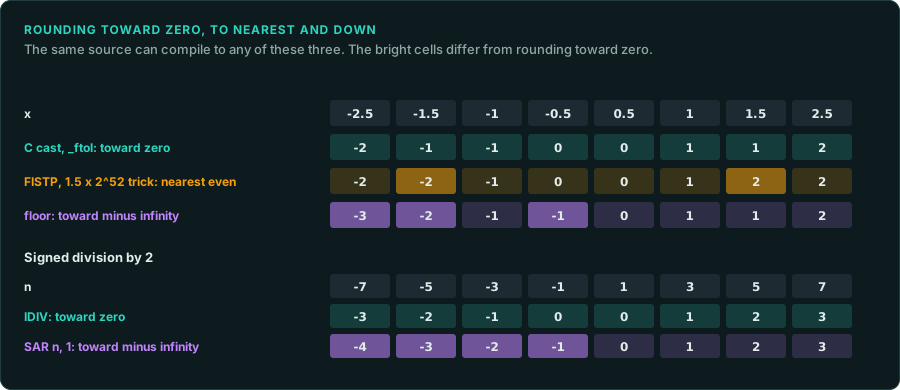
cvttss2sitruncates toward zero (a C cast);cvtss2sirounds with the current mode (lrintf). Ghidra writes both as a cast; the instruction tells you which. - min and max.
minss a, breturns b when either is NaN, so keep the original's operand order. - Fused multiply-add. A compiler may turn
a * b + cinto one FMA instruction with one rounding instead of two. Look forvfmaddin the original; avoid accidental FMA in the reimplementation (compiler flags such as-ffp-contract=off). - Maths functions.
sinf,cosf,atan2f,powf,expfcome from the C runtime the game shipped with. They differ in the last bit between runtimes. Emulate them and reimplement the original's versions when the simulation depends on them. - Denormals and rounding mode live in MXCSR (SSE) or the x87 control word. Games sometimes enable flush-to-zero for speed; check the start-up code for
ldmxcsror_controlfp.
Integers
Integers on every platform covers division by zero, overflow and shift counts on each CPU and in each port language.
- Division rounds toward zero in C (
-7 / 2 == -3); Python's//rounds down (-4). saris an arithmetic (signed) shift,shra logical one; Ghidra shows both as>>.- Overflow wraps in machine code; languages that check or widen (Rust debug builds, Python) need explicit wrapping.
imul/idivare signed,mul/divunsigned. Take the type from the instruction, whatever type Ghidra declares.movsxloads a byte or a 16-bit value as signed,movzxas unsigned. This shows whether acharorshortfield is signed.- C widens
charandshortvalues tointbefore it computes with them. The result is cut back only when it is stored. A sum of two 8-bit values can therefore go above 255 inside an expression, and a compare sees that full value. - An operation on two types first converts one operand to the other's type. With an
intand afloat, theintbecomes afloat(cvtsi2ss,fild) before the operation. Dividing twointvalues, then storing the result in afloat, divides as integers first. With a signed and an unsigned value of the same width, the compare is unsigned, so-1 < 0uis false. Convert at the same point as the original.
Further reading
- Microsoft: x64 calling convention, https://learn.microsoft.com/cpp/build/x64-calling-convention
- System V AMD64 ABI, https://gitlab.com/x86-psABIs/x86-64-ABI
- Igor Skochinsky, "Compiler internals: exceptions and RTTI" (MSVC C++ layout)
- Bruce Dawson, "Floating-point determinism" and the "Comparing floating point numbers" series