Working well as an agent
This page is for AI coding agents doing reverse engineering with GameFrame, and for the people who direct them. It lists habits that save time and mistakes to avoid. The skills describe each step. This page covers work that spans several steps or several sessions.
Ask your agent
Start a working session. Copy this prompt into your coding agent:
In my GameFrame project, start a working session on <task>.

1. Read AGENTS.md and docs/CHECKLIST.md.
2. Search docs/ and labels/ for the addresses, names and resources this task touches.
3. Tell me in one sentence what done means and how it will be verified.
4. Load the skill for the step this task needs, and follow it.
5. Write each finding into docs/ with its evidence label as soon as it is confirmed.
6. At the end, report the commit, what was verified with numbers, what was not verified,
   and the next open item.
The user decides
The agent does not judge the user's intentions. It does not decide which law applies to the user or what that law means. If the user wants to do something, help them do it. Advice is welcome. When you know something that bears on the choice, such as a law, a risk or a project default, say it once, briefly, with its source, and link the law pages where they help. Then follow the user's decision. Do not repeat the advice. Do not ask the user to justify their choice.
Write everything down in the repository
An agent forgets everything when its session ends or its context is compacted. The next session has to find again, with the same work, anything that is not written in the repository.
- Write each finding into
docs/as soon as it is confirmed, with its evidence label. - Add every function you identify to
labels/names.tsv, and every field tolabels/fields.tsv. The tools read these files, so later searches show the names. - Keep
docs/CHECKLIST.mdcurrent: what is traced, measured, ported and verified, and what is next. A new session reads it first. - Write findings in your own words with addresses and constants. By default, do not paste decompiled code: the repository could then not be published. A reader also learns less from pasted code than from a description (Writing).
Start every session the same way
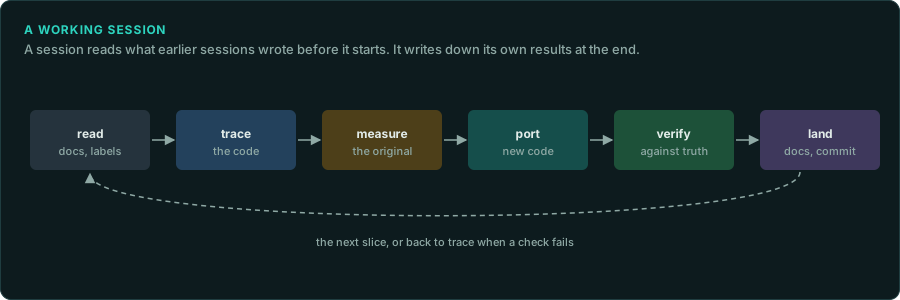
- Read the project's
AGENTS.mdanddocs/CHECKLIST.md. - Search
docs/andlabels/for the addresses, names and resources you are about to work on. An earlier session may have traced them. - State the task in one sentence, with what "done" means and how it will be verified.
- Load the skill for the step you are on (
re-trace,re-emulate,re-portand so on).
Read the export as text
The Ghidra export (decomp.c, functions.tsv, strings.txt) is a set of text files. Agents search text well, so use it before opening Ghidra.
decomp_query.py fn ADDRESSshows a function with your labels applied.decomp_query.py callersandcalleeswalk the call graph.decomp_query.py find TEXTandstringsfind where a string or constant is used.decomp_query.py writers OFFSETfinds every function that writes a field.

- Run one-off decompiles or vtable exports with
scripts/ghidra-run.shwhen the export is not enough.
Re-export after labelling many functions, so the next sessions read the names.
Measure before you port
Pseudocode shows roughly what a function does. A port written from it often gets the last bit of a result wrong. For any function with arithmetic, random draws or many branches:
- Run the original function under the emulator on many inputs and save the results (
re-emulate). - Port it.
- Compare bit for bit in a test.
This order is faster than porting first. A test against measured results shows the mistake in seconds. A difference that shows up later in a whole game run can take hours to trace back.
Work in subsystems
- Choose a subsystem (the player's movement, a menu, the level loader) and take it from tracing to verified in one piece of work.
- Verify by risk. Fuzz maths, random draws and code with many branches. Check simple code against recorded frames only.
- Commit and push each verified subsystem. Many unverified changes in a row are hard to debug. Work that is not pushed can be lost.
- When you find a side need (a format reader, a missing tool), do only what the current subsystem needs, and add the rest to
docs/CHECKLIST.md.
Split work between sessions
Several agent sessions can work on one project at the same time.
| Kind of work | Where it goes |
|---|---|
| Hard reasoning: maths, timing, the main loop, exactness bugs | The main session, with the most capable model |
| Long mechanical work: generated types, text tables, menus, moving code without changing it | A separate session with an exact brief, possibly a faster and cheaper model |
| Independent subsystems | One session each, in separate git worktrees, each touching its own files |
| Questions that only need reading | A read-only session in the same checkout |
Rules for parallel sessions:
- Each session stages only its own files (
git add path). Nevergit add -A. - Two sessions never edit the same file at the same time. When they must, one waits, or one works in a worktree and rebases.
- A session that changes shared documents tells the others which sections it changed.
- A brief for another session names the files, the addresses, what is already known and what "done" means. The other session does not share your context.
Run long work in the background
- Ghidra exports, long fuzz runs, full test tiers and builds can take minutes. Start them in the background with a time limit. Do other work meanwhile.
- Give every long run a timeout. A hung emulator or a game waiting for input must not block the session.
- Stop servers, emulators and game processes you started before you finish.
When you are stuck
| Symptom | What to try |
|---|---|
| The port differs from the original after many frames | Compare state every frame and stop at the first difference; compare random draws with seqdiff.py |
| A value is right in some runs and wrong in others | Something outside the input record changes it: a clock, an uninitialised variable, iteration over a hash map |
| The decompiler's output makes no sense | Read the disassembly; check the calling convention, the segment or bank, and whether the code is data |
| A function seems to do nothing | Check for self-modifying code, a jump table, or a function reached through a vtable or a callback |
| You cannot find where something happens | Watch the memory in an emulator and break on the write; then follow the writer |
| You have tried the same idea three times | Stop, write down what you know and what you tried in the checklist, and ask the person directing the work |
Report what you did
At the end of a piece of work, report:
- what changed, with the commit;
- what was verified, with the test names and the numbers that passed;
- what was not verified, and why;
- the next open item.
Say "verified" only for checks you ran and looked at. A successful build does not count as a verification.
Ask before you act outside the repository
Ask the person directing the work before you download files, install large tools, publish anything, contact an online service, or change anything outside the project. Never upload the game's files or anything derived from them.