The same floats on every platform
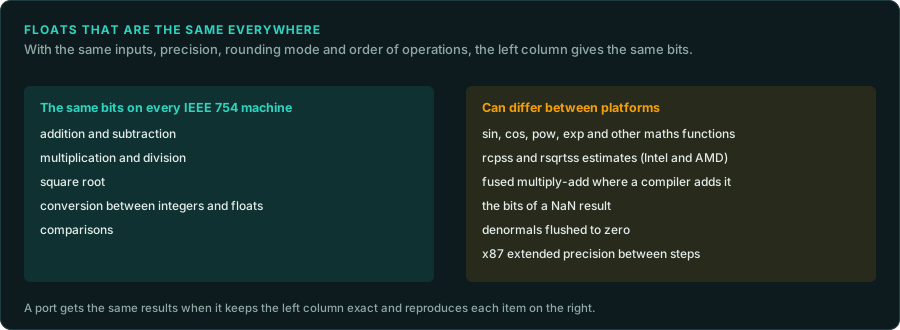
A port of a game that uses floating point must give the same numbers as the original, often on a different CPU and in a different language. IEEE 754 makes this possible for the basic operations. Several other things still differ between platforms. This page lists them, from the point of view of the port. Calling conventions and floating point covers the x87 and SSE instructions in the original, and CPUs and floating point the history.
What IEEE 754 makes exact
Addition, subtraction, multiplication, division and square root are correctly rounded. Given the same inputs, the same precision and the same rounding mode, every IEEE 754 machine gives the same bits. So does a conversion between an integer and a float. A port that does the same operations, in the same order, at the same precision, gets the original's results on any modern CPU.
Each condition matters:
- The same order. Float addition is not associative.
(a + b) + canda + (b + c)can differ in the last bit. Keep the original's order of operations, and keep compilers from changing it (no-ffast-math, no/fp:fast). - The same precision. A
floatsum that the original stored after each step must be rounded tofloatafter each step in the port. x87 code that kept 80 bits between steps needs the extra precision at the same places. - The same rounding mode. Round to nearest, ties to even, unless the original changed the mode. A game that sets the mode for a fast float-to-integer conversion changes it for every other operation too.
What still differs
| Item | Where it differs | What to do |
|---|---|---|
Maths functions (sin, pow, exp) | Every C runtime, every language and every GPU has its own versions, which differ in the last bit | Port the original's routine, or the routine of its C runtime, and test it against the original |
Estimate instructions (rcpss, rsqrtss) | Intel and AMD CPUs give different results; only a maximum error is specified | Measure them on the CPU the reference captures came from, and use a table or a formula that gives those bits |
| Fused multiply-add | A compiler may fuse a * b + c into one rounding | Fuse only where the original's instruction did; turn contraction off elsewhere |
| NaN bits | A NaN made from numbers (0 / 0, infinity minus infinity) is negative on x86 (0xFFC00000 for a float) and positive on ARM (0x7FC00000); WebAssembly allows either. A NaN that comes in as an operand goes out unchanged, apart from being made quiet, on x86 SSE and on ARM in its default mode. An x86 mulss and a Rust build on ARM both return a 0x7FC00000 input as 0x7FC00000 (measured) | Matters only if the game stores, hashes or compares NaN bits; then keep the original's operations, so that a NaN input passes through the same way |
| Multiplying by −1 | The original's x * -1.0 returns a NaN unchanged. A compiler may turn the port's x * -1.0 into a negation, which flips the NaN's sign bit: LLVM does this in a release build (observed). Writing c - x instead loses the -0 that the multiply gives at x = c | Negate only a number, and pass a NaN through: if x.is_nan() { x } else { -x } |
| Denormals | 32-bit ARM NEON always flushes them to zero; games may set flush-to-zero on x86 | Copy the original's setting, and test with very small values |
| Text to number | atof and strtod were not always correctly rounded in old runtimes, and they read the decimal separator from the locale | Parse with the original's routine, or check every number the game reads from text |
Platforms with their own rules
- PlayStation. No floating-point unit. The geometry coprocessor (GTE) works in fixed point. See Integers on every platform.
- PlayStation 2. The Emotion Engine's FPU is not IEEE 754. It has no infinities, no NaNs and no denormals, it rounds toward zero, and it clamps overflows to the largest value. Emulators such as PCSX2 add code to copy this, and a port must do the same.
- GameCube and Wii. Paired-single instructions compute two floats at once. Their estimate instructions (
ps_res,ps_rsqrte) give the console's own results, which Dolphin reproduces from measurements. - GPUs. Shader arithmetic is not required to be IEEE-exact, and
mediumpmay use 16-bit floats. Results used by the game's rules must be computed on the CPU.
In the port's language
- Rust.
f32andf64operations are IEEE operations, and the compiler does not reorder them.f32::sinand similar call the platform's maths library, so they differ between platforms. Write the original's versions instead. The compiler may still rewrite an operation into another one with the same result for every number, such asx * -1.0into-x. Such a rewrite can change the bits of a NaN (see the table above).f32::min,f32::maxandf32::clampalso treat NaN in their own way:minandmaxreturn the other value, andclampreturns the NaN. Port the original's comparisons instead of these functions where a NaN can reach them. - JavaScript. Every number is a 64-bit double.
Math.froundrounds to 32 bits, so afloatoperation isMath.fround(Math.fround(a) * Math.fround(b)).Math.sinand the other functions are implementation-defined and differ between browsers. - WebAssembly.
f32andf64operations are IEEE operations with one rounding each. Only the bits of NaN results may vary. There are no fused operations unless the code asks for them. - C#. On .NET Core,
floatoperations use SSE and round tofloat. On the old .NET Framework for 32-bit x86, the JIT used the x87 and kept extra precision. Unity games running on Mono may also show this. Check which runtime the original used.
How to check
- Run each float routine of the original under emulation on many inputs, including values near zero, near overflow, negative zero and NaN (re-emulate). Some C runtime routines handle NaN and infinity on a separate path. MSVC's
sqrtfpasses them to its maths error handler, which an emulator that has not started the runtime does not have, so the emulation stops there (observed). Read that path in the disassembly, or start the runtime first. - Compare the port's bits exactly with
tools/verify/bitcompare.py, with no tolerance. - Run the same comparison on every platform the port ships on, including the browser.
- When a value differs, find the first operation that differs. It is usually an order of operations, a missing rounding to
float, or a maths function.
What to record
- The precision of each value the rules use, and where the original rounds it.
- The rounding mode and the denormal setting at start-up, and any later changes.
- Every maths function and estimate instruction the rules use, and how the port reproduces it.