Library behaviour that shows in results
A game calls its C runtime and its standard library for random numbers, sorting, formatting, time and containers. The C and C++ standards say what each function must do, but they leave the details to each runtime. Microsoft's, Borland's, Watcom's and GNU's runtimes made different choices. A port that calls its own runtime's rand or qsort gets different results from the original, even when every line of the game's own code is exact.
This page lists the functions whose differences reach the player, and what to do about each. The rule for all of them is the same. Find which runtime the game was linked with (Recognising an engine), then port that runtime's version of each function the rules use. GameFrame's crates include some of them. gameframe-msvc-crt has measured MSVC math, sorting and random-number routines. It also has source-derived byte, string and integer text functions that still need runtime comparison.
Random numbers
rand returns the next number of a generator whose algorithm the standard does not fix.
| Runtime | Algorithm | After srand(1) |
|---|---|---|
| Microsoft C | state = state x 214013 + 2531011; return bits 16 to 30 | 41, 18467, 6334 |
| Borland C and Turbo C | state = state x 22695477 + 1; return bits 16 to 30 | 346, 130, 10982 |
| GNU C library (glibc) | an additive generator with 31 words of state | 1804289383, 846930886, 1681692777 |
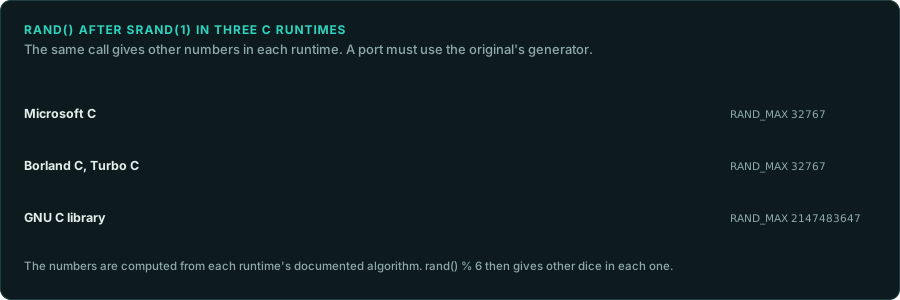
RAND_MAX differs too: 32767 for Microsoft and Borland, 2147483647 for glibc. A game that computes rand() % 6 gets other dice in a port that uses another runtime. Port the original's generator, keep its state where the original keeps it, and draw in the same order. The re-randomiser agent finds every caller.
Sorting
qsort is not stable, and each runtime sorts in its own way. Elements that compare equal come out in an order that depends on the algorithm.
- Microsoft C. A quicksort with a median-of-three pivot, and a selection sort for partitions of 8 elements or fewer.
- glibc. For many years a merge sort when it could allocate memory, which kept equal elements in order, and a quicksort otherwise. Later versions changed this.
- C++
std::sort. An introsort in every major library, with its own thresholds. Equal elements come out in a library-specific order.
A game that sorts units by distance, or sprites by depth, shows the order of equal elements on screen or in its rules. Port the original's sort exactly, including its pivot choice and its threshold. Un-Banished's crt_qsort_by is an example. A stable sort in the port gives a different order.
Formatting and parsing numbers
printfwith floats. The Universal CRT in Visual Studio 2015 changed howprintfformats floating-point numbers, to print the exact decimal value and round it correctly. A game built with an older runtime can show a different last digit for the same value. Port the original's formatting where the game shows numbers or writes them to saves.atofandstrtod. Old runtimes did not always round the parsed value correctly. A number read from a text file of rules can differ in its last bit between runtimes.- The locale. A C program runs in the "C" locale until it calls
setlocale. Aftersetlocale(LC_ALL, "")on a German or French system,printfwrites3,5andatofstops reading at the comma. See Text and encodings. - Integer conversion. The MSVC crate provides source-derived
strtol,strtoul,strtoll,strtoulland integer-to-text routines. It uses C-locale whitespace and ASCII digits. Compare it with the game's CRT before relying on overflow or locale edge cases.
Time
clock. On Microsoft's runtime it returns the wall-clock time since the program started, in units of 1/1000 second. On POSIX systems it returns the processor time the program has used, in units of 1/1,000,000 second. A game that times its frames withclockruns at a different speed if the port takesclockfrom another runtime.timeandlocaltime. The time zone and summer time rules come from the system. A game that shows dates or seeds its generator from the clock depends on them. Make the clock an input of the port (Inputs).
Containers and hashing
- Hash tables.
std::unordered_map,stdext::hash_mapand similar containers iterate in an order set by the hash function and the bucket count. Each library has its own. A game that loops over a hash table and acts on each element in turn depends on that order. - Hashes of pointers. A table keyed by object addresses iterates in an order set by where the allocator placed the objects. That order changes between runs, between runtimes and between allocators. If the original depends on it, its behaviour may differ from run to run. Record that as a finding before choosing what the port does.
std::setandstd::map. Ordered by their comparison, so the order is the same everywhere, as long as the comparison is the same.
Memory functions
memcpywith overlapping buffers. Undefined by the standard. The original'smemcpycopied in a fixed direction, and a game that relied on it got that result. Usememmovein the port only if the original's result matches it.- Uninitialised memory. The original read whatever was there, such as zeros from a fresh heap page or old data from a reused block. If a value comes from uninitialised memory, measure what the original got in practice, and give the port that value.
What to record
- The C runtime and C++ library the game was linked with, with the evidence.
- Every library function the rules call, and how the port reproduces each one.
- Every place where the original's behaviour depends on addresses or on uninitialised memory.