Flash and Shockwave games
Thousands of games were made for Adobe Flash Player and for Macromedia Shockwave (Director) between the late 1990s and the 2010s. Most were played in a web browser. Adobe ended Flash Player on 31 December 2020 and blocked Flash content from 12 January 2021 (Adobe: Flash Player end of life). Shockwave Player ended in April 2019. Many of these games survive only as files in archives, with no way to run them in a current browser. This page describes how the files are built, how to read their code and their assets, and the routes to a working version.
What a Flash game is
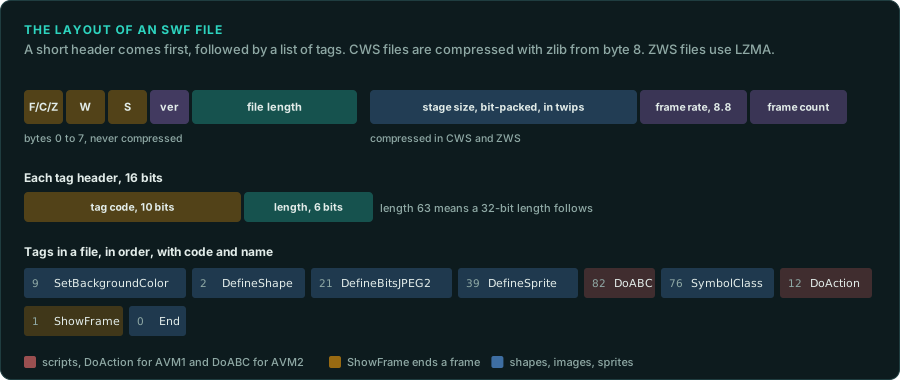
A Flash game is an SWF file, sometimes several. It holds vector shapes, bitmaps, sounds, fonts, a timeline of frames, and compiled scripts. Adobe published the format as the SWF File Format Specification (version 19 is the last) and the script machine as the AVM2 Overview.
| Part | Where it is | Notes |
|---|---|---|
| Header | The first bytes | FWS uncompressed, CWS zlib from byte 8, ZWS LZMA. Then the version, the length, the stage size in twips (1/20 pixel), the frame rate and the frame count |
| Tags | After the header | Each tag has a code and a length. Shapes, bitmaps, sounds, sprites (movie clips with their own timeline), text, buttons, scripts |
| ActionScript 1 and 2 | DoAction, DoInitAction tags | Byte code for the first script machine (AVM1). Scripts sit on frames, buttons and clips |
| ActionScript 3 | DoABC tags | Byte code for AVM2, introduced with Flash Player 9 in 2006. Classes, linked to library symbols by SymbolClass |
| Saves | Local shared objects (.sol files) | Written by SharedObject, encoded in AMF0 or AMF3, in Flash Player's #SharedObjects folder |
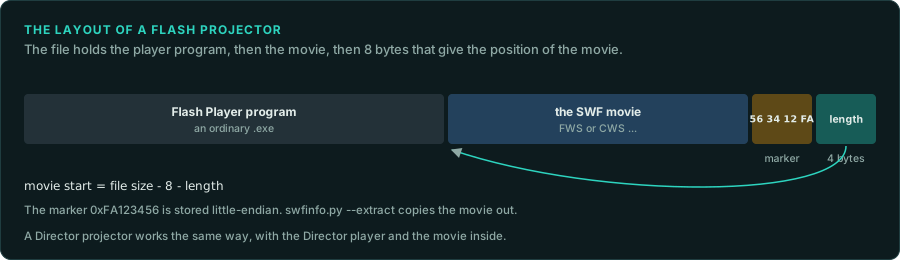
A Flash projector is a standalone program with the movie inside. A Windows projector is the Flash Player program with the SWF appended at the end. The last 8 bytes hold the marker 0xFA123456 and the movie's length.
tools/formats/swfinfo.py reads any of these:
python3 tools/formats/swfinfo.py target/game.swf                     # version, stage, scripts, content
python3 tools/formats/swfinfo.py target/game.exe --extract derived/game.swf   # the movie from a projector
python3 tools/formats/swfinfo.py target/game.swf --decompress derived/game-fws.swf --tags
python3 tools/triage/filetypes.py target --summary                   # finds every SWF in a folder
Reading the code and the assets
JPEXS Free Flash Decompiler (FFDec) is the main tool. It is open source. It decompiles ActionScript 1, 2 and 3. It exports shapes as SVG, bitmaps as PNG, sounds, fonts, texts and the timeline. It also has a command line, which suits agents (ffdec -export script,image,sound,shape derived/ffdec target/game.swf). It can also debug a running movie.
Things to look for in the code:
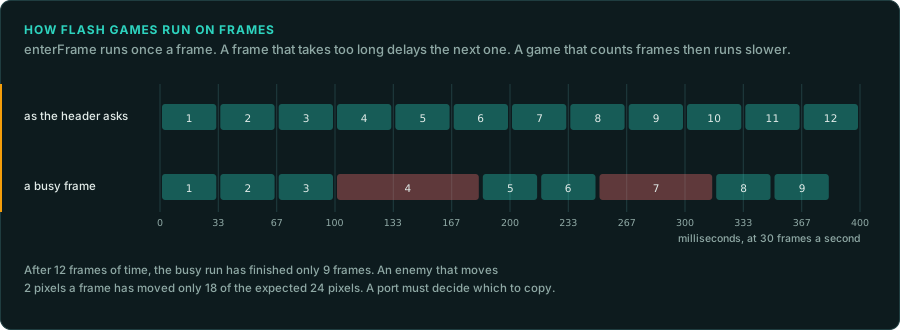
- The main loop. Flash games run on frames. Look for
enterFramehandlers (AS3Event.ENTER_FRAME, AS2onEnterFrame) and timers. The frame rate in the header sets the step. When the player cannot keep up, frames run late, and a game that counts frames runs slower. - Randomness.
Math.random()takes no seed, so a run cannot be repeated. A port that must match a recording has to record the draws, or replace the generator with a seeded one (re-verify). - Numbers. ActionScript
Numberis an IEEE double. AS3 also has 32-bitintanduint. Integer overflow, string to number conversion andMathfunctions follow the player's rules. Port those rules exactly where the game depends on them. - Loaded content. A game can load other SWFs, images and XML at run time, by URL or from bytes in its own library (
Loader.loadBytes). Some games hide their real movie this way, encrypted inside a small loader. Let the loader run in a debugger or in Ruffle, and save the bytes it loads. - Site locks and services. Many games check the web address they run from (
loaderInfo.url,_root._url) and refuse to start elsewhere. Many also called score, advertising or account services that no longer exist. Note each check and each service. The port leaves them out, or replaces a service with a local one. - Obfuscation. Some games were run through an obfuscator, which renames classes and methods to meaningless or unprintable names and adds junk code. FFDec has options to rename identifiers and to remove some of the junk. The behaviour is still all there.
Running the original
Ruffle is a Flash Player emulator written in Rust. It runs in a browser through WebAssembly and as a desktop program. Its support for ActionScript 1 and 2 is broad. Its ActionScript 3 support is growing, and its site lists what is missing. Ruffle is the usual place to watch and capture the original today (Observing the original). For games Ruffle cannot run yet, the Flash Player projector (the "content debugger" build) still runs on Windows.
Flashpoint Archive is a preservation project that collects Flash, Shockwave and other web games. It runs them in their original players with a local web server, which also answers site locks. It records each game's source and launch settings. It is often the best place to find a game's files and the other files it loads.
Routes to a port
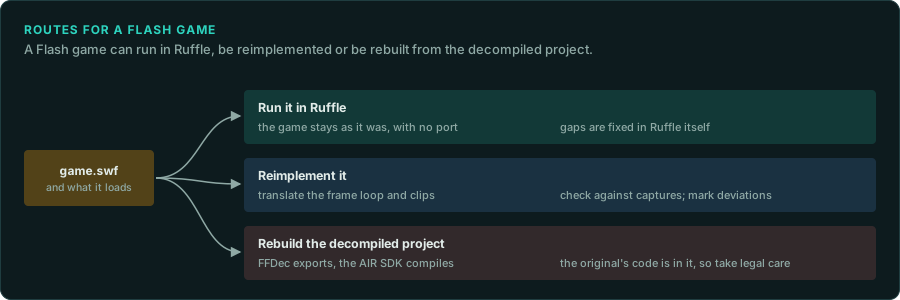
- Run it in Ruffle. This is preservation. The game stays as it was. It needs no port. Where Ruffle lacks a feature the game uses, the work is in Ruffle, and Ruffle's developers welcome reports and fixes.
- Reimplement it with GameFrame's method. The decompiled scripts are much closer to the source than machine code is. Most of the work is translation of the frame loop and the movie clips. The vector art is exported as assets or redrawn. Check the port against captures from Ruffle or the projector. Mark every difference as a Deviation.
- Rebuild the decompiled project. FFDec can export an AS3 project that the AIR SDK compiles again. This keeps the code as it was. It also needs the most care about the law, because the result contains the original's code (Legal). The owner of the project decides.
Shockwave and Director
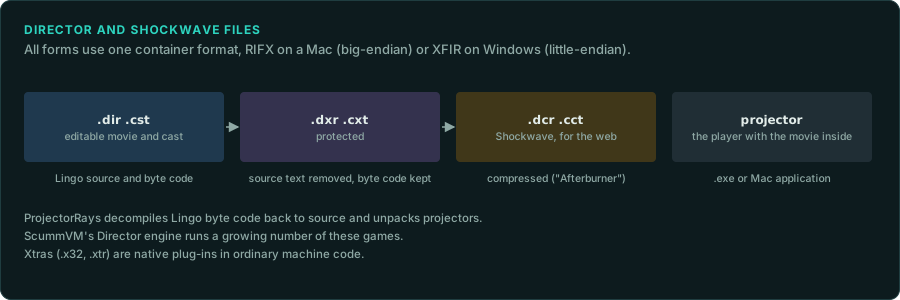
Macromedia Director made CD-ROM games and Shockwave web games, with scripts in Lingo.
| File | What it is |
|---|---|
.dir, .cst | A Director movie and cast, editable |
.dxr, .cxt | The same, protected: the scripts' source text removed, the byte code kept |
.dcr, .cct | Shockwave movie and cast for the web, compressed ("Afterburner") |
A projector .exe or Mac application | The Director player with the movie inside |
Xtras (.x32, .xtr) | Native plug-ins in machine code, for features Director lacked |
The files are RIFF containers: RIFX from a Mac (big-endian), XFIR from Windows (little-endian). swfinfo.py and filetypes.py recognise them. ProjectorRays decompiles Lingo byte code back to source and unpacks projectors. ScummVM runs a growing number of Director games with its Director engine. Its compatibility list shows which ones. An Xtra is ordinary machine code. Trace it with the method's usual tools.
Other web players
Java applets and Unity Web Player games were lost in the same way. A Java applet's classes decompile well with CFR, Procyon or Vineflower. A Unity Web Player file (.unity3d) is a Unity asset bundle. Engine-era PC games covers Unity.
What to record
- Each SWF or Director file: its hash, its version, its compression, and which file loads it.
- The ActionScript version, the main classes or frames, the frame rate, and every loaded file or service.
- Site locks, services, and any obfuscation, with how the port treats them.
- Where the copy came from: the site, the archive, the date.
Ask your agent
In my GameFrame project, look at the Flash game in target/.

1. Read docs/engines/flash-and-shockwave.md.
2. Run tools/formats/swfinfo.py on each SWF or projector, and extract any movie from a
   projector into derived/.
3. If JPEXS FFDec is installed, export the scripts and assets into derived/ffdec. Ask me
   before installing it.
4. Record in docs/FINDINGS.md the version, the ActionScript version, the frame rate, the main
   classes, every file or service the game loads, and any site lock.
5. Suggest a route: Ruffle, a reimplementation, or both. Commit nothing from target/ or derived/.