Identifying unknown files
A game folder holds executables, archives, pictures, sounds, levels, scripts and saves. Many use formats the developer invented. This page describes how to say what a file is, and what it holds, before you find the code that reads it. The tools are tools/triage/filetypes.py, tools/triage/similar.py, tools/formats/xorscan.py and tools/formats/timestamps.py. Each result here is a lead. Confirm it in the code that reads the file (re-format).
Kind, from the first bytes
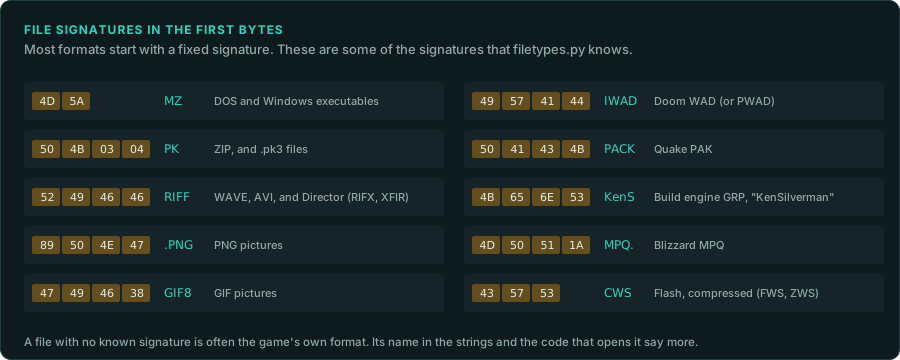
Most formats start with a fixed signature. filetypes.py knows the common ones: executables (MZ, NE, LE, PE, ELF, Mach-O), archives (ZIP, RAR, 7-Zip, cabinets, LHA, ARJ), game archives (WAD, PAK, GRP, MPQ, BIF, Unreal and Unity packages), pictures (PCX, BMP, GIF, PNG, IFF ILBM, DDS), sounds and music (WAVE, VOC, MIDI, XMIDI, HMP, MOD, S3M, XM, IT, Ogg) and video (FLI, FLC, Smacker, Bink, AVI).
python3 tools/triage/filetypes.py target --summary
python3 tools/triage/filetypes.py target
A file with no known signature is often one of the game's own formats. Its extension, its name in the executable's strings and the code that opens it say more than its bytes.
Entropy
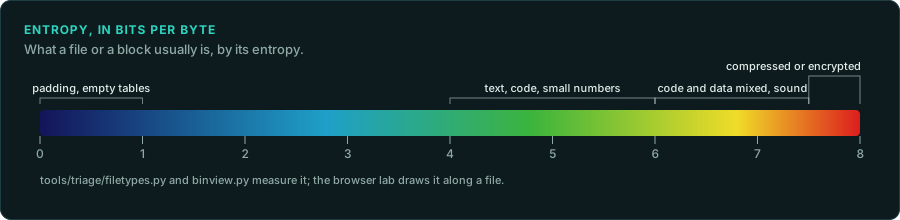
Entropy measures how evenly the byte values are used. It runs from 0 to 8 bits per byte.
| Entropy | Usually |
|---|---|
| Below 1 | Padding, an empty table, a mostly blank picture |
| 4 to 6 | Text, code, tables of small numbers, uncompressed pictures with few colours |
| 6 to 7.5 | Code and data mixed, 16-bit sound, tables of floats |
| Above 7.5 | Compressed or encrypted data |
--blocks N gives the entropy of each block of N bytes. In an archive, a flat run of high values is compressed entries. A header or a directory shows as a dip. In an executable, a high run where the code should be suggests a packed program (Packed and protected code).
A picture of the file
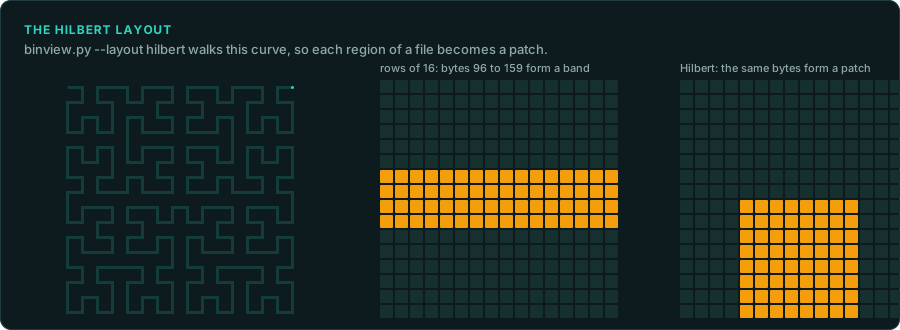
tools/triage/binview.py draws a file one pixel per byte. Black is zero, blue is text, red is bytes above 0x7F, and green is control bytes. Compressed data is red speckle. A table of fixed-size records shows as stripes, and lines up when the width is a multiple of the record size. --colour entropy colours by entropy instead. --layout hilbert keeps neighbouring bytes together, so each region of the file is a patch.
python3 tools/triage/binview.py target/data/level1.dat derived/level1.png --width 24
python3 tools/triage/binview.py target/GAME.EXE derived/game.png --layout hilbert --colour entropy
The file explorer does the same in the browser, with an entropy graph and a hex view of any place you click.
Pictures in the data

A block of a data file, or a dump of video memory, may be a picture with no header. Try it as one with tools/formats/rawimage.py: 8 bits per pixel (VGA mode 13h), Mode X planes, EGA bit planes, CGA, packed 4, 2 or 1 bit pixels, and 16-bit colour, with a palette from a file or the hardware's default. A wrong width shows as slanted stripes. Change it until the picture stands straight. The pixel explorer does this interactively.
python3 tools/formats/rawimage.py target/data/TITLE.SCR derived/title.png --mode linear8 --palette target/data/GAME.PAL
python3 tools/formats/rawimage.py derived/vga-planes.bin derived/frame.png --mode modex --palette derived/dac.bin
Structure, from the numbers
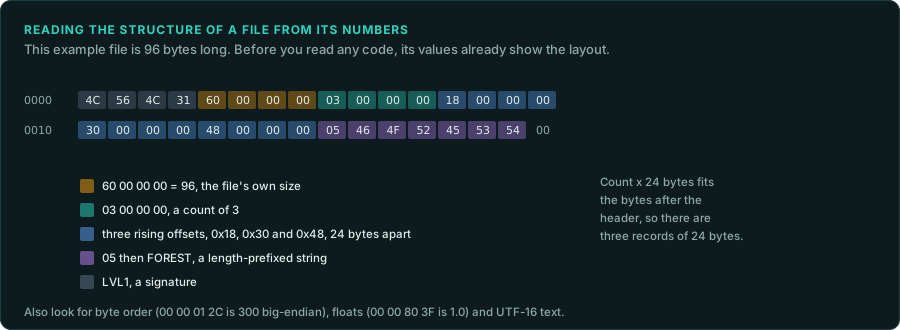
Before any code is read, the numbers in a file often show its layout.
- The file's own size. A 32-bit value equal to the file's length, or to the length minus a header, is a size field.
- Counts. A small number near the start, followed by that many records of the same size, is a count. Check that count times stride matches the bytes that follow.
- Offsets. A list of increasing values, each inside the file, is a table of offsets. The gaps between them are the entries' sizes.
- Strings. A byte or a 16-bit or 32-bit value followed by that many printable bytes is a length-prefixed string. A run of printable bytes ending in
00is a C string. Text in pairs with zero bytes between letters is UTF-16. Japanese games may use Shift-JIS. - Bit fields. Flags, small counts and packed coordinates often share a byte. Codes in compressed data and passwords run across byte boundaries.
reader.py'sbits(n)reads them, low bits first by default, or high bits first. - Byte order. Values like
00 00 01 2C(300 big-endian) suggest a big-endian format: Amiga, Atari ST, classic Mac, most consoles and network data.tools/formats/reader.pyreads both orders and LEB128 variable-length numbers. - Floats.
00 00 80 3Fis 1.0 as a little-endian 32-bit float. Runs of values ending in3F,40,41,42,BForC0are often floats.
Two files compared
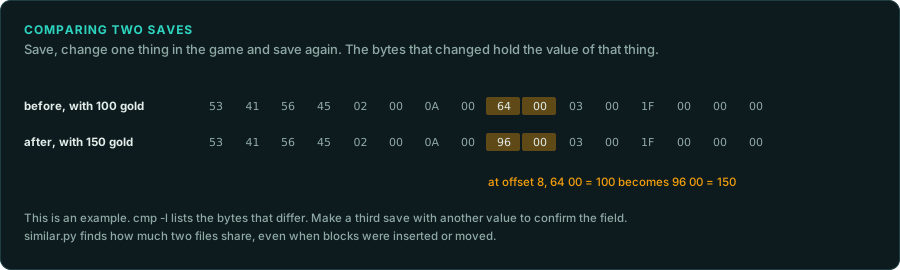
Comparing two versions of a file is often faster than reading one. Make a save, change one thing in the game, and save again. The bytes that changed hold that thing.
python3 tools/triage/similar.py saves/a.sav saves/b.sav      # how much the two share
cmp -l saves/a.sav saves/b.sav | head                         # which bytes differ
similar.py cuts each file into pieces at points the content chooses, then counts the bytes in pieces that match. An inserted or removed block changes only the pieces around it. Uses:
- how far two releases or two patches are apart, file by file (
similar.py DIR_A DIR_B); - a file renamed or moved between versions;
- how much of an executable matches a known library build;
- which saves or levels are near copies of each other.
tools/triage/compare_trees.py answers the simpler question of whether two copies are identical.
Algorithms, from their constants
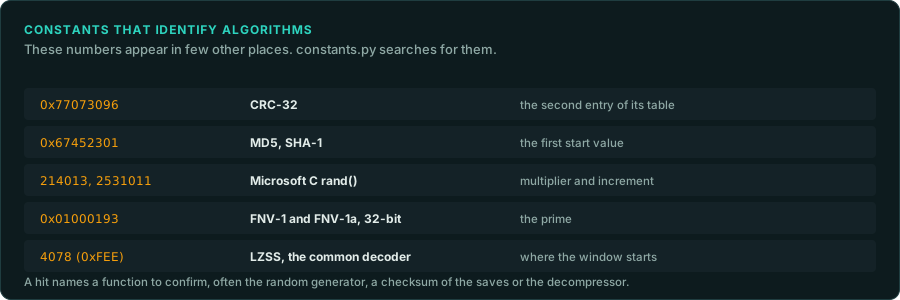
Many algorithms carry numbers found nowhere else: the multiplier of a random number generator, the first entries of a CRC table, the start values of MD5, the 4078-byte window start of the common LZSS decompressor. tools/triage/constants.py searches for them:
python3 tools/triage/constants.py target/GAME.EXEA hit names the algorithm and gives the address. tools/triage/tables.py finds the sine and cosine tables, and says how each was made: steps per circle, scale, type and rounding. The function at that address is often the random number generator, the checksum of the save files, or the decompressor of the data files. Confirm it in the code before you port it.
Resources inside executables
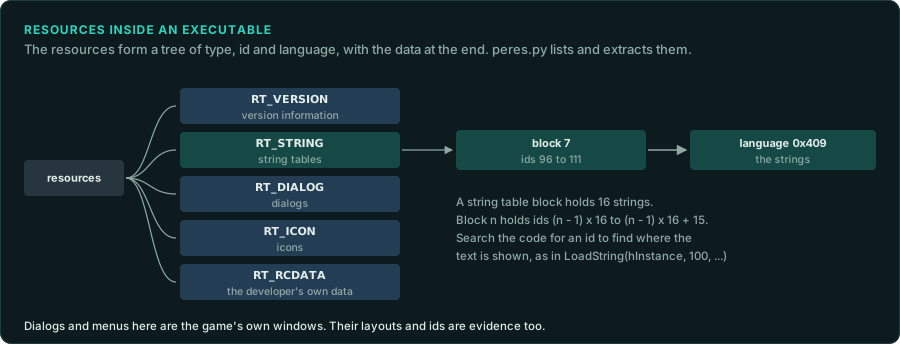
A Windows executable carries resources: version information, string tables, dialogs, menus, icons, bitmaps, and data the developer packed in as RCDATA. tools/pe/peres.py lists them, prints the version information and the string tables, and extracts each one:
python3 tools/pe/peres.py target/GAME.EXE                     # every resource, and the version
python3 tools/pe/peres.py target/GAME.EXE --strings           # the string tables, with their ids
python3 tools/pe/peres.py target/GAME.EXE --extract derived/resources
The ids in a string table are the numbers the code passes to LoadString. Search the export for an id to find the code that shows the text.
Simple obfuscation
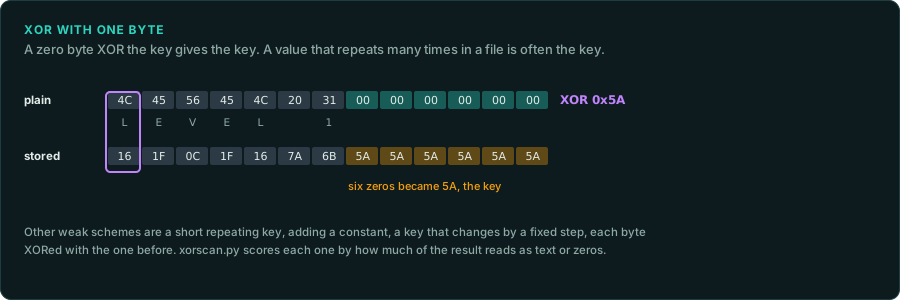
Some games hide text, scripts and tables from casual viewing. The common schemes are weak: XOR with one byte or a short repeating key, adding a constant, a key that changes by a fixed step for each byte, or each byte XORed with the one before. A file with text-like entropy (4 to 6) that shows no readable text is a candidate. So is a file whose bytes are full of one repeated value other than zero, because XOR turns zeros into the key.
python3 tools/formats/xorscan.py target/data/script.dat
python3 tools/formats/xorscan.py target/data/sound.dat --known 52494646@0     # "RIFF" at 0
python3 tools/formats/xorscan.py target/data/script.dat --apply xor-key:1f2e3d -o derived/script.txt
The tool scores each scheme by how much of the result is zeros or readable text, and shows a preview. A strong result still needs the code. The key may change per file or per entry, and the bytes may also be compressed. If no scheme reads well and the entropy is high, the data is compressed or uses a real cipher. Then find the decoder in the code that reads the file. Look for a loop that changes each byte of a buffer right after the file is read.
Timestamps

Saves record when they were made. Executables record when they were linked. Archives and file systems record each file's date.
python3 tools/formats/timestamps.py 0x2E6B7A40                       # every reading of one value
python3 tools/formats/timestamps.py --scan saves/a.sav --from 1996 --to 1998| Kind | Where it appears |
|---|---|
| Unix seconds since 1970 | C time(), the PE header's link time, many saves |
| FAT date and time | DOS directory entries, ZIP headers, INT 21h AX=5700h |
| Windows FILETIME | Windows saves and registry values: 100 ns steps since 1601 |
| Mac seconds since 1904 | Classic Mac files and HFS volumes |
| OLE date | Visual Basic and Office files: days since 1899-12-30, as a double |
A scan of a whole file finds noise as well as fields. Keep the years narrow. A field is real when a save made later has a later value at the same offset. FAT and Mac times are local time, so a value can be off by the time zone of the machine that wrote it.
What to record
- Each file type: its signature, its entropy, and which code reads it, with the address.
- Each field found by comparison, with the two files and the change that showed it.
- Each obfuscation scheme, with its key and the function that applies it.
- Each timestamp field, with its kind and its offset.